


Child Atopic Dermatitis Treatment

Medically reviewed by Dr. Evelyn Tay
FRCP (Edinburgh), FAMS (Dermatology)
Atopic dermatitis can cause persistent itching, dry and inflamed skin, disturbed sleep and repeated flares in children. Symptoms may begin in infancy and change as a child grows. Some children have occasional mild patches, while others experience eczema that repeatedly returns despite regular skin care.
Lumine Dermatology & Laser Clinic provides atopic dermatitis treatment for babies, children and teenagers in Singapore. Treatment is planned according to the child's age, the areas affected, the severity and frequency of flares, previous treatment response and any signs of infection or another skin condition.
How Atopic Dermatitis Appears in Children
Children with this condition often have dry, easily irritated skin that becomes inflamed during flares. Atopic eczema develops when skin barrier dysfunction and immune inflammation make the skin more reactive to everyday triggers. The skin loses moisture more easily and becomes more susceptible to irritation and inflammation. Itching often leads to scratching, which can further damage the skin and prolong a flare.
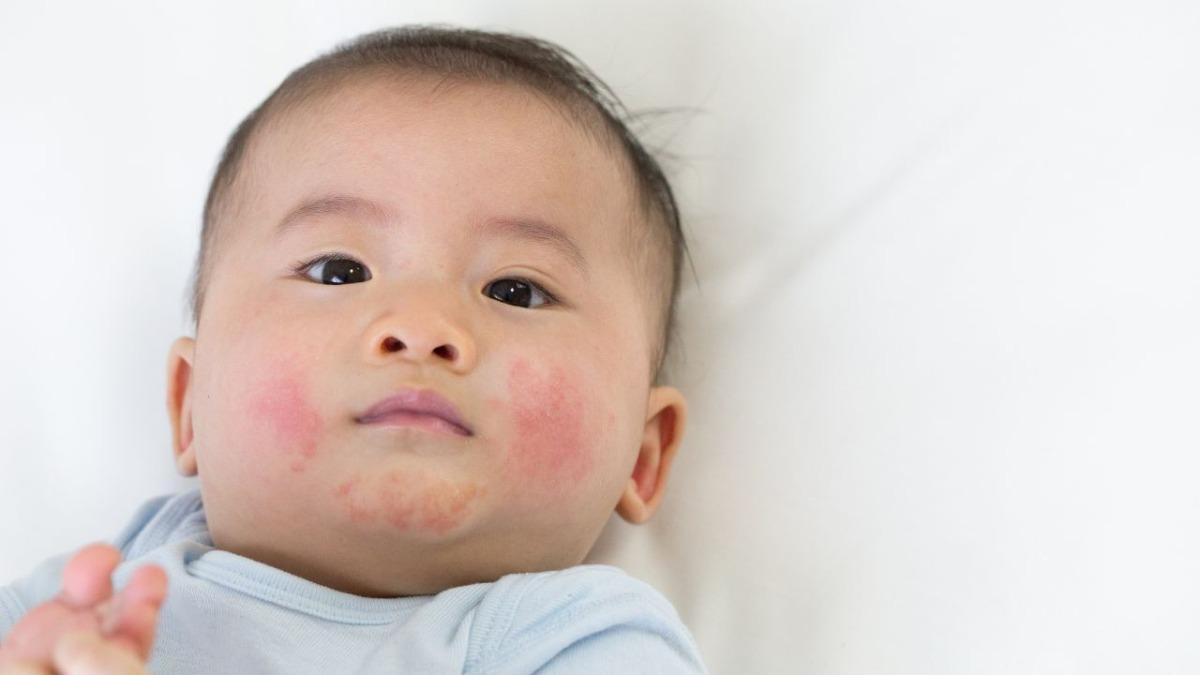
The pattern changes with age. Babies commonly develop eczema on the cheeks, scalp and outer parts of the arms and legs. Older children often develop it around the elbows, behind the knees, on the neck, hands or eyelids. Long-standing scratching can make affected skin thicker and more prominent.
Eczema can also appear differently across skin tones. In more deeply pigmented skin, inflammation may look brown, purple-grey or darker than the surrounding skin rather than bright red. Texture, swelling, dryness and scratch marks may provide clearer signs of active disease.
Why Flares Keep Coming Back
Flaring tends to come from a combination of skin barrier dysfunction and immune inflammation. Genetics can contribute, particularly in families with eczema, asthma or allergic rhinitis. Everyday exposures can then aggravate skin that is already prone to inflammation.
Singapore’s heat and humidity can aggravate eczema, particularly when sweating increases during outdoor activity or exercise. Damp clothing, prolonged heat exposure and repeated friction can intensify itching in children whose skin is already inflamed.
The goal is to identify factors that repeatedly affect your child and combine sensible avoidance with consistent skin care and appropriate treatment for inflammation.
When Your Child Should See a Dermatologist

A dermatology review may be appropriate when eczema keeps returning, spreads across a larger area, causes persistent scratching or begins to disturb sleep. Eczema affecting the eyelids, face, hands or other sensitive areas may need treatment selected specifically for that location.
Assessment is also needed when the rash does not respond as expected. Fungal infections, contact dermatitis, scabies, psoriasis and other childhood skin conditions can sometimes resemble eczema. Confirming the diagnosis prevents repeated treatment of the wrong condition.
Seek prompt medical care if your child's skin becomes increasingly painful, swollen, wet or heavily crusted, or if your child develops fever or appears unwell. Rapidly appearing painful blisters or sores in a child with eczema require urgent assessment because they may indicate eczema herpeticum.
What We Look for During the Consultation
The consultation considers both the current rash and the eczema pattern over time. We assess where the eczema occurs, how often it returns, the severity of itching, sleep disruption, and the treatments already tried. We also review moisturisers, cleansers and prescribed creams to see how they are being used and how the skin has responded.
The skin examination looks for active inflammation, scratching, thickened areas and signs of secondary infection. Different parts of the body may require different treatment strengths or formulations, particularly the eyelids, face and skin folds.
Most children do not need routine allergy testing to diagnose atopic dermatitis. Testing may be considered when the history suggests a specific food allergy, allergic contact dermatitis or another defined trigger. Broad allergy panels without a clear clinical reason can lead to unnecessary dietary restrictions.
How We Treat Atopic Dermatitis in Children
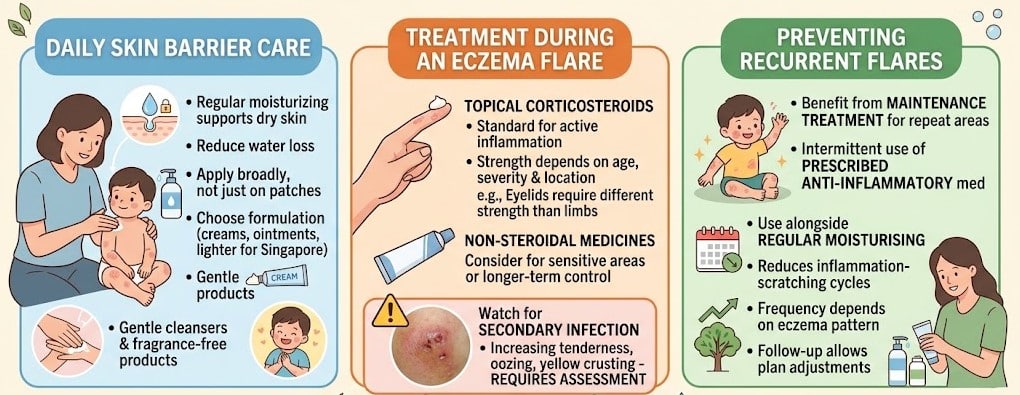
Treatment needs to address both the active flare and the skin between flares. During a flare, treatment focuses on controlling inflammation, while care between flares supports the skin barrier and reduces the chance of another episode. An atopic dermatitis treatment plan should also be practical for parents to follow consistently at home.
Daily Skin Barrier Care
Regular moisturising reduces water loss and supports dry, eczema-prone skin. Moisturisers are usually applied across areas that tend to become dry rather than only on visible eczema patches.
The formulation can be adjusted to the child's skin and daily routine. Richer creams or ointments may suit very dry skin, while lighter formulations may feel more comfortable in Singapore's warm climate. Gentle cleansers and fragrance-free products are often preferred for skin that irritates easily.
Treatment During an Eczema Flare
Topical corticosteroids remain a standard treatment for active eczema. The appropriate strength depends on the child's age, the severity of inflammation and the area being treated. Thin skin around the eyelids requires a different approach from thicker eczema on the limbs.
Non-steroidal topical medicines may be considered for selected children, particularly when eczema repeatedly affects sensitive areas or requires longer-term control. Parents receive instructions on how much medication to apply, where to use it and how long treatment should continue.
If eczema becomes secondarily infected, treatment may also need to address the infection. Increasing tenderness, oozing or yellow crusting can indicate bacterial involvement and should be assessed rather than managed with repeated anti-inflammatory treatment alone.
Preventing Recurrent Flares
Children who repeatedly develop eczema in the same areas may benefit from maintenance treatment after the visible flare has settled. In selected cases, prescribed anti-inflammatory medication can be used intermittently on flare-prone sites alongside regular moisturising.
This approach can reduce repeated cycles of inflammation and scratching. Treatment frequency depends on the child's eczema pattern, the areas involved, and the medication prescribed. Follow-up allows the plan to change as symptoms improve or the disease pattern changes with age.
When Eczema Is More Severe
Some children continue to experience extensive eczema, severe itching, frequent infections, or significant sleep disturbance despite appropriate topical treatment and skin care. At this stage, treatment technique, adherence, possible infection, and alternative diagnoses should be reviewed before moving to more advanced therapy.
For selected children with moderate-to-severe atopic dermatitis, systemic treatment or biologic therapy may be considered based on age, disease severity, and previous treatment response. These treatments require specialist assessment and ongoing monitoring.
The treatment goal is sustained disease control. A child who repeatedly moves from one severe flare to the next may need a different long-term strategy rather than another short course of the same treatment.
How Lumine Dermatology Can Help

Lumine Dermatology & Laser Clinic provides assessment and treatment for children with recurrent atopic eczema, persistent itching and eczema that has not improved sufficiently with previous care. We review the current rash alongside the child's longer-term flare pattern, treatment history, skin care routine and any features suggesting infection or another diagnosis.
Treatment may include adjustments to daily skin barrier care, topical anti-inflammatory medication, management of secondary infection and a maintenance strategy for areas that repeatedly flare. Children with more severe disease can be assessed for additional treatment options when topical therapy no longer provides adequate control.
Eczema patterns often change as a child grows, so treatment may need to change with them. If your child continues to have frequent flares, disrupted sleep or persistent eczema despite treatment, Lumine Dermatology can reassess the condition and develop a clearer plan for longer-term control.
Frequently Asked Questions
Is atopic dermatitis the same as eczema?
Atopic dermatitis is the most common type of eczema in children and is often called atopic eczema. Eczema is a broader term that includes several inflammatory skin conditions, so not every childhood rash described as eczema has the same cause or treatment.
Are steroid creams safe for children?
Doctors commonly prescribe topical corticosteroids for childhood eczema. The strength, amount and duration need to match the child's age, the severity of the flare and the body area being treated. Correct use reduces inflammation while limiting the risk associated with unnecessarily prolonged or inappropriate application.
Does my child need allergy testing?
Most children with atopic dermatitis do not need routine allergy testing. Consider testing when a child repeatedly develops an immediate reaction after a particular food or when clinical history suggests another allergy.
Why does my child’s eczema return after the skin has cleared?
Since atopic dermatitis is a relapsing condition, visible improvement does not always mean that the tendency to develop inflammation has disappeared. Some children repeatedly flare in the same areas and may need regular moisturising or prescribed maintenance treatment between episodes. If flares remain frequent despite following the treatment plan, the child may need reassessment to identify what is contributing to poor control.

Dr. Evelyn Tay
FRCP (Edinburgh), FAMS (Dermatology)

